The Kitchen That Runs Itself: Appliance Choices That Matter

In this article
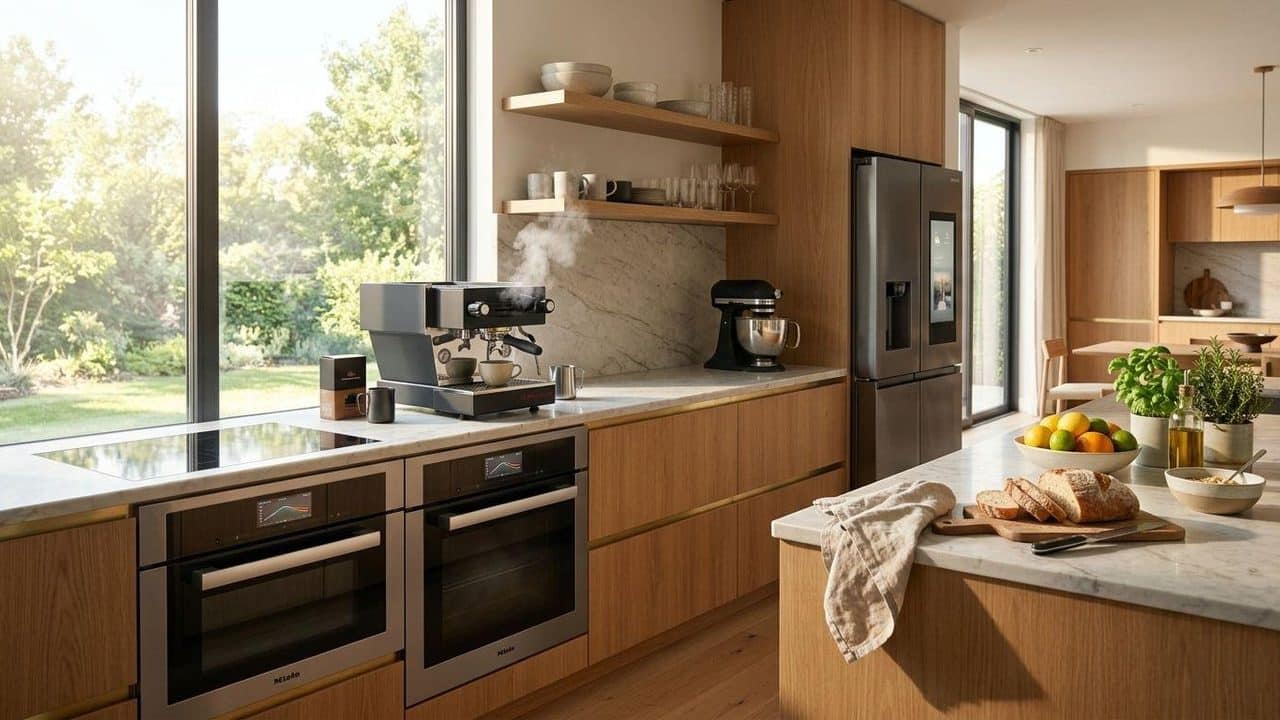
Some kitchens seem to hum along on their own. Meals get prepared, groceries get stored, and the space stays usable without a running list of small chores in the background. Others feel like they demand constant attention: a freezer that ices up, a fridge that hums too loudly at breakfast, cabinet fronts that never quite match. The difference rarely comes down to habits or discipline. It usually traces back to a handful of design decisions made when the room was planned — and the best kitchen appliances are the ones that quietly absorb those daily tasks instead of adding to them.
This article explains why some kitchens feel like they run themselves, tracing it back to specific appliance design choices you can actually evaluate before buying. The focus is not on gadgets or countertop appliances that sit unused after a month, but on the structural choices — how a fridge is installed, how a freezer manages ice, how noise travels through an open-plan room — that shape the daily rhythm of a household for years.
Why small kitchen frictions accumulate into daily stress
What makes one kitchen feel high-maintenance and another feel effortless is rarely a single flaw. It is the slow accumulation of micro-tasks that nobody scheduled: wiping condensation off a door seal, defrosting a freezer drawer that has crusted over, shuffling containers because the shelf height does not match the leftovers, checking whether the temperature drifted overnight. Each task takes a minute or two. Together, they form what could be called maintenance debt — the invisible interest a household pays on appliance choices made years earlier.
Maintenance debt is different from breakage. Nothing has failed. The appliance still works. It simply requires more attention than a better-designed alternative would. A freezer that needs manual defrosting once or twice a year is not broken; it just quietly claims an afternoon of your calendar. A fridge with awkward drawer geometry is not defective; it just makes you re-stack groceries every time you shop.
The reason this matters is cognitive rather than practical. People rarely notice individual friction moments, but they do notice how a room feels to live in. A kitchen that constantly interrupts you with small demands feels tiring, even if you cannot name why. A kitchen that stays out of your way feels calm. The appliances are doing the same job in both cases — the difference is how much of that job stays hidden from you.
The hidden design choices behind a low-maintenance kitchen
The appliance features that actually reduce daily upkeep are usually not the ones highlighted in marketing brochures. Colour finishes, smart displays and app connectivity attract attention, but they rarely change the daily rhythm of the room. The choices that do matter are more structural and easier to overlook on a showroom floor.
The first is freezing technology. A traditional freezer builds up frost because warm, humid air enters every time the door opens; that moisture condenses on the cold interior walls and freezes solid. Over months, the ice layer thickens, insulates the cooling coils and forces the compressor to work harder. Frost-free or no-frost systems circulate cold, dry air and channel any moisture away before it settles, which prevents the ice sheet from forming in the first place. The mechanism matters more than the label: what you are really buying is the elimination of a recurring chore.
The second is installation type. A freestanding unit sits as a visible object in the room; a fully integrated unit is built behind cabinet fronts and reads as part of the kitchen line. The difference is not only visual. Integrated units are designed for continuous cabinetry airflow, which affects how ventilation is routed, and their hinges are engineered to carry a decorative door panel — meaning the appliance disappears into the room rather than dominating it.
The third, often ignored until it is too late, is noise. Open-plan layouts turn the kitchen into part of the living space, and a compressor that was tolerable behind a closed door becomes a constant background presence at the dinner table. Checking the decibel figure on a spec sheet takes a minute; living with the wrong choice takes years.
How built-in refrigeration technology reduces manual upkeep
A fully integrated fridge-freezer changes the daily routine in specific, measurable ways compared to a standalone unit — not because it cools better, but because it removes tasks from the household calendar. The integration itself matters: because the appliance is installed behind cabinet fronts as part of the kitchen design, ventilation, hinge behaviour and shelf geometry are planned around continuous cabinetry rather than a freestanding box dropped into a gap. That planning shows up in small daily moments — a door that closes flush without adjustment, drawers that pull cleanly past the surrounding cabinet, and no visible seam collecting crumbs at the base.
The larger shift comes from what happens inside the freezer compartment. No-frost technology is designed to prevent the buildup of ice that would otherwise require manual defrosting, which means the recurring task of emptying the freezer, unplugging it, and waiting for it to thaw simply disappears from the household routine. For anyone who has ever spent a Saturday morning with towels on the floor, this is not a small change; it is the removal of a category of work.
Two planning factors deserve attention when a household considers a built in Fridge Freezer as part of a wider kitchen update: total usable volume relative to shopping habits, and the aperture height of the cabinet niche relative to the appliance body. Undersize the volume and daily reorganising returns. Get the aperture wrong and the whole run of cabinetry has to be adjusted, which is the kind of avoidable friction good planning is meant to prevent. Both are cheap to check on paper and expensive to fix after installation.
Practical questions to ask before your next kitchen update
Before choosing appliances for a low-maintenance kitchen, a short list of concrete questions saves more time than any brand comparison. The questions below apply across manufacturers and price ranges, and they focus on the decisions that shape daily life rather than the ones that shape the invoice.
- Installation type: Is the appliance intended to sit as a freestanding object, to slot in with a visible metal frame, or to disappear fully behind cabinet fronts? Each option implies different hinge hardware, ventilation routing and cabinet planning.
- Freezing technology: Does the freezer compartment use a no-frost or automated defrost system, or will manual defrosting remain part of the yearly routine?
- Noise profile: What is the operating decibel figure, and where will the appliance sit relative to seating and sleeping areas in an open-plan layout?
- Aperture and volume: Does the cabinet niche match the appliance body precisely, and does the total interior volume match the household’s actual weekly shopping pattern rather than a theoretical family size?
- Timing: The best time of year to buy kitchen appliances is usually tied to model-year transitions and seasonal retail cycles, so aligning a purchase with a planned kitchen update — rather than an urgent replacement — tends to widen the choice.
Beyond the built-in categories, common kitchen appliances and countertop appliances follow the same logic: the ones that stay useful for years are the ones whose maintenance profile matches the household. A stand mixer that requires disassembling every part after each use will migrate to a cupboard within months. Kitchen machines that clean quickly, store compactly and handle the two or three tasks a household actually does — rather than the twenty tasks a demo video promises — end up on the counter permanently. The same principle applies whether the shortlist is a top 10 kitchen appliances article, a manufacturer’s kitchen appliance list, or a personal note on a phone: what matters is fit, not features.
Frequently Asked Questions
What is the difference between an integrated and a fully integrated appliance?
An integrated appliance is designed to sit within a cabinet run but often keeps a visible metal front or control panel. A fully integrated appliance is built to accept a decorative door panel matching the surrounding cabinetry, so the appliance body itself is not visible from the room. The distinction affects both the visual line of the kitchen and the hinge hardware required, since a fully integrated door must carry the extra weight of the cabinet panel.
What does 'total volume' mean practically for a household?
Total volume is the combined interior capacity of the fridge and freezer compartments, usually stated in litres. Practically, it matters less as an absolute number and more in relation to shopping habits. A household that shops twice a week for fresh produce needs less cold storage than one that does a single large weekly shop with batch-cooked meals, even if both have the same number of people. Matching volume to routine prevents both wasted space and daily reorganising.
Are the best kitchen appliances for baking always the most expensive?
Not necessarily. For baking specifically, consistent temperature control and even heat distribution matter more than headline features or premium finishes. A mid-range oven with reliable thermal behaviour and a straightforward interface will outperform a feature-heavy model whose settings are rarely used correctly. The same holds for cool appliances marketed on aesthetics: longevity depends on the mechanism inside, not the surface treatment outside.